
A Day Trip to Cannes from Nice: What Is Worth It and What Is Not
Cannes is west of Nice, the opposite direction from Monaco — and the real reason to come is not La Croisette but the Lérins islands. What the beaches cost, the view from Le Suquet, how to reach the islands, and what the town is like during the festival.
First, the compass: Cannes is west
Half the Riviera itineraries ever written go wrong for one reason: people assume Cannes is next to Monaco. It is not. Monaco is east of Nice, Cannes is west — exactly opposite directions, with Nice in the middle. You cannot do both in one day without losing two hours on trains and your good mood with them.
With that settled, Cannes is an excellent day trip, about half an hour away by rail. The same regional line that runs east to Monaco and Menton runs west to Antibes, Juan-les-Pins and Cannes; how it works, what it costs and what to check before leaving is in our guide to the Riviera by train. The Nice–Cannes fare is comparable to Nice–Menton — indicatively around €7–8 one way, 2026 — and, as everywhere on this line, nothing needs booking in advance.
Cannes station is in the centre, ten minutes' walk from La Croisette and fifteen from the old port. It is one more argument for Nice as a base: you reach the whole coast without a car.
La Croisette: what it actually is
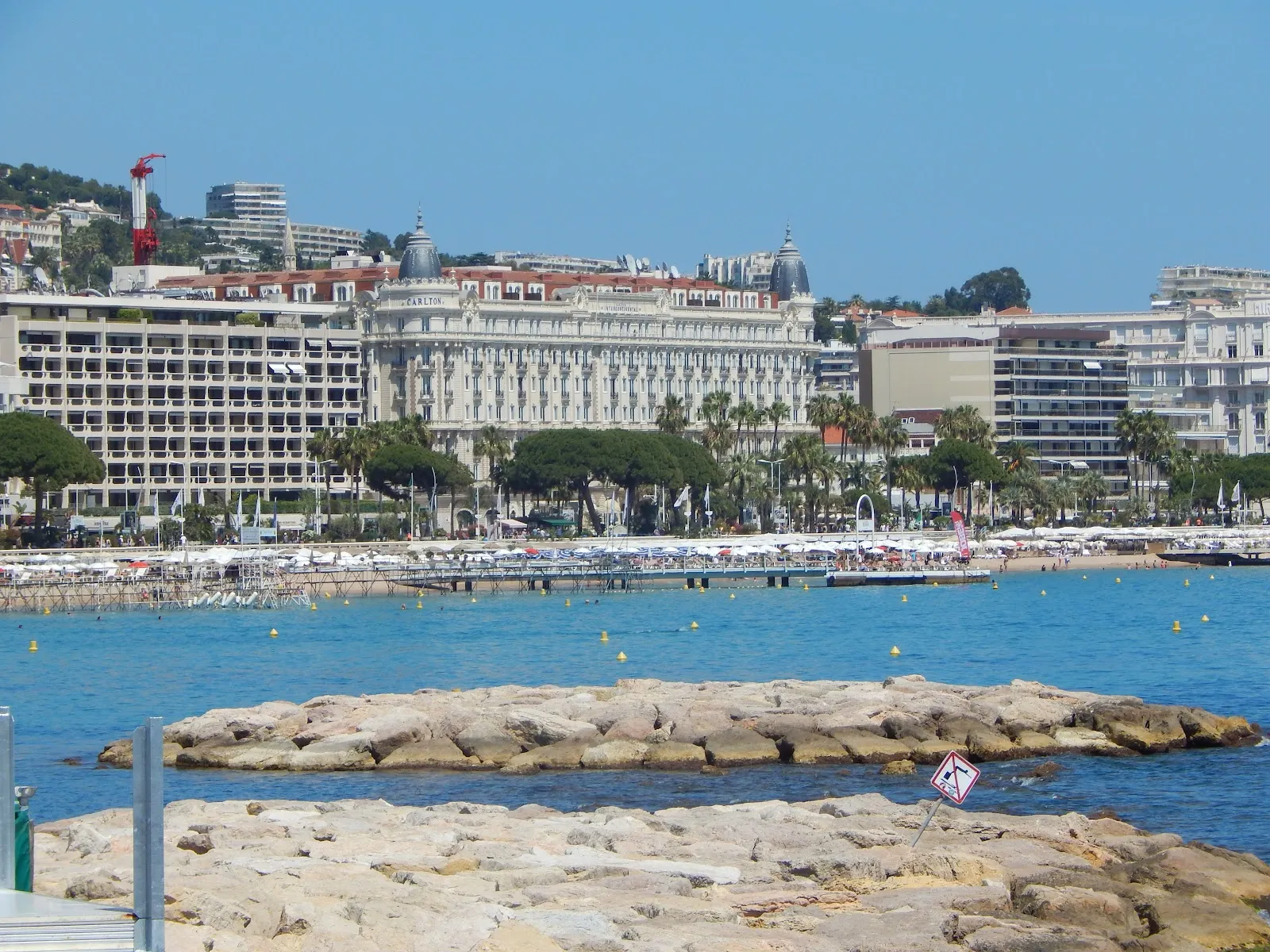
The seafront boulevard, with its palms and its palace hotels, is the town's trademark image. Let us be clear about what is there: La Croisette is essentially a luxury shopping street with a sea view. Fashion-house windows, a handful of grand hotels with real history — the Carlton, the Majestic, the Martinez — and a wide pavement that everybody strolls at sunset. It is pleasant. It is not a sight.
The beaches in front of it are almost all private concessions belonging to the hotels and beach clubs: you go in, pay for a lounger and parasol, and get table service and a shower. Indicatively, for 2026, a lounger on a Croisette beach club runs around €30–60 a day, more at the top hotels and in the front row, with food on top at good-restaurant prices. There are free public stretches too — smaller, busier, perfectly decent — and the sand on the Croisette is real sand, brought in and maintained, not the cobbles Nice trains you to expect.
If the plan is a coffee at the Carlton and some people-watching, the budget is reasonable. If the plan is a luxury beach day, this is the most expensive option on the coast after Monaco; the area's luxury hotels generally include beach access for guests, which changes the arithmetic.
Le Suquet, the old town, and the view
Old Cannes is the hill at the western end of the bay, Le Suquet, and it is the best half hour of climbing in town. Narrow lanes, pastel houses, stairways, small restaurants along the Rue Saint-Antoine — another world from the Croisette, ten minutes away on foot.
At the top sit the remains of the medieval castle of the Lérins abbots, with the Tour du Mont Chevalier, the square 11th-century tower, and the Musée des Explorations du Monde. The view from up there — the bay, the whole Croisette, the yacht harbour and, offshore, the two islands — is the only overview of the town you will get. The climb is short but genuine, up steps.
At the foot of the hill, the Marché Forville is the covered market: local produce, fish and cheese, mornings, closed on Mondays when it turns into a brocante. It is where Cannes looks like a working town rather than a set.
The Lérins islands: the real reason to come
This is the part most day-trippers miss, which is a shame, because it is the best thing in Cannes.
Fifteen minutes by boat from the old port, opposite the Croisette, lie two islands.
Sainte-Marguerite is the large wooded one: pines and eucalyptus, paths the whole way round, small coves with transparent water and almost nothing built. At the end nearest town stands Fort Royal, the fortress where the Man in the Iron Mask was held; it can be visited for a modest fee (indicatively under €10, 2026) and houses a museum of marine archaeology. The island takes two to three hours on foot with a swim stop. Carry water — facilities are thin.
Saint-Honorat is the small one, and it is still today the property of a working Cistercian monastery, home to a community of monks who farm vines and lavender. You visit quietly, on a path that circles the island in about an hour, past the old chapels and the fortified monastery tower on the southern shore. It is not an attraction park: modest dress and quiet are expected, there is no topless sunbathing, and the wine made here is sold at the abbey shop at collector prices.
The two islands are served by different operators, leaving from the same old port; a return ticket runs, indicatively, around €17–22 for Sainte-Marguerite and similar for Saint-Honorat (2026), and the last boat back is earlier than you expect — it is the one timetable of the day you genuinely must check.
If you have one day and want one thing from Cannes, take the boat.
The Palais des Festivals and the festival
The Palais des Festivals, the bulk of a building at the western end of the Croisette, is the home of the film festival. Outside festival time it is an unremarkable congress centre with a red staircase at the front, a row of celebrity handprints set into the pavement (the Allée des Étoiles) and a tourist office. Three minutes and a photograph.
In May, for the roughly twelve days of the festival, the town becomes something else: the centre fills with barriers, parts of the Croisette are closed off, hotels are full at several times the usual rate, and restaurant tables are booked weeks ahead. The main screenings are by invitation — you cannot buy tickets as a tourist — although there are public beach screenings and accessible parallel sections. The practical conclusion: if you want the atmosphere and the circus, come then, with everything reserved long in advance. If you want the town, avoid those dates.
For the rest of the year, Cannes runs a dense calendar of congresses and trade fairs that fill the hotels without showing on the street — reason enough to check the events calendar before you book a room.
A day that works
Morning: train from Nice, coffee on the Croisette, up into Le Suquet for the view, back down through the Marché Forville. Lunch in the old town, not on the boulevard. Afternoon: boat to Sainte-Marguerite, walk and swim, back on one of the late sailings. Evening: train to Nice in time for dinner.
The beach variant: reverse it — boat in the morning, when the islands are empty, and the Croisette in the afternoon.
The honest part
Cannes is less interesting than its reputation. The Croisette is a shopping street, the beaches are mostly paid for, the Palais des Festivals is an ordinary building, and the old town, pretty as it is, is small. Cannes is worth a day, not three, and it is worth it mainly for the islands and the view from Le Suquet.
Do not pair it with Monaco. If you are staying in Cannes and want the principality, it is over an hour by train with a change at Nice, and it works as a day trip in its own right — we explain how in Monaco from Cannes. For the full context of the town, with hotels, restaurants and sights, there is our Cannes page.
Two small things that matter: Cannes station is central, so you need no local transport in town, and if you want the islands plus Le Suquet plus a sit-down meal, the day is full — pick two of the three.
Plan your trip
Experiences
Tours & activities
Private tours, boat trips and hand-picked experiences via GetYourGuide — free cancellation on most.
See all experiencesGetting to the Riviera
Flights, transfer & car
Nice → Monaco transfer
Private transfer, fixed price, driver waiting — 30 minutes along the coast.