
The French Riviera by Train: Fares, Stops and How the Coastal Line Works
A single railway links the entire Riviera, from Cannes to Italy, and a ticket costs a few euros. How the line works, what is at each stop, journey times, where to buy, and what can go wrong.
The line that holds the Riviera together
A single railway runs from Marseille to Ventimiglia, in Italy, following the coast so closely that for long stretches the sea is twenty metres from the window. The regional trains on it — TER services, sold by the Provence-Alpes-Côte d'Azur region under the Zou! brand — are the most useful thing anyone can tell you about a French Riviera holiday, and the thing most guides bury under a paragraph about car hire.
The logic holds from your first morning. Riviera distances are small, the towns are strung along one line, and the stations sit in the middle of them. Nice to Monaco takes about 25 minutes and costs about €6.10. Nice to Menton takes about 40 minutes and costs about €7.70. For what a single day of car hire plus parking costs, you can ride the whole coast for a week. That is the real reason Nice works as a Riviera base better than anywhere else on the coast — not because it is the prettiest town, but because everything is a train ride from its station.
What follows is the full guide to this line: how it works, what is actually at each stop, what it costs, how to buy and validate a ticket, how to read the timetable, and — the part everyone skips — what can go wrong.
Why the train beats driving here
On the Riviera, a hire car is a trap that looks like freedom.
The first problem is parking. In Nice, Villefranche, Beaulieu or Menton, sea-level spaces are few, paid and full by nine in the morning in season. In Monaco, where the underground car parks are genuinely excellent and well signed, you pay by the hour for the privilege, and you enter and leave the principality on a small number of roads that jam predictably. We have a separate guide to parking in Monaco if you are determined to drive — but the better question is whether you need to.
The second problem is the road itself. The three Corniches between Nice and Monaco are spectacular and, for precisely that reason, busy: narrow, hairpinned, slowed by tour coaches, and short on places to pull over for the view you came for. In summer and at weekends, twenty kilometres can take an hour. The train does it in 25 minutes whatever the traffic is doing.
The third problem is that you simply do not need one. Almost everything worth seeing between Cannes and Ventimiglia has a station within a few minutes' walk. The real exceptions are the hill villages — Èze-Village, Saint-Paul-de-Vence, Gourdon — and for those you take the bus up or, if you want a day arranged end to end, a private tour.
Stop by stop, eastbound from Nice
The order of stations, west to east, is: Nice-Ville, Nice-Riquier, Villefranche-sur-Mer, Beaulieu-sur-Mer, Èze-sur-Mer, Cap-d'Ail, Monaco-Monte-Carlo, Roquebrune-Cap-Martin, Carnolès, Menton, Menton-Garavan, Ventimiglia. Not every train calls at every one. Here is what is actually there.
Nice-Ville is the main station and your base camp: about ten minutes on foot from Avenue Jean Médecin, tram at the door, machines, counters and shops inside.
Nice-Riquier serves the Riquier district in the east of the city. If you are staying there, start here and skip the trip into the centre; otherwise it is not a reason to get off.
Villefranche-sur-Mer — get off. It is the first stop out of Nice and, for the effort involved, the best value on the whole line: a deep natural harbour, an ochre old town with stairways instead of streets, and a bay of sand and shingle rather than Nice's cobbles. We have written up a day in Villefranche-sur-Mer in full.
Beaulieu-sur-Mer is quiet, well kept and very convenient: the station is beside the port, and the walking path towards Saint-Jean-Cap-Ferrat starts here. Best combined with Villefranche — they are one stop apart and also linked on foot.
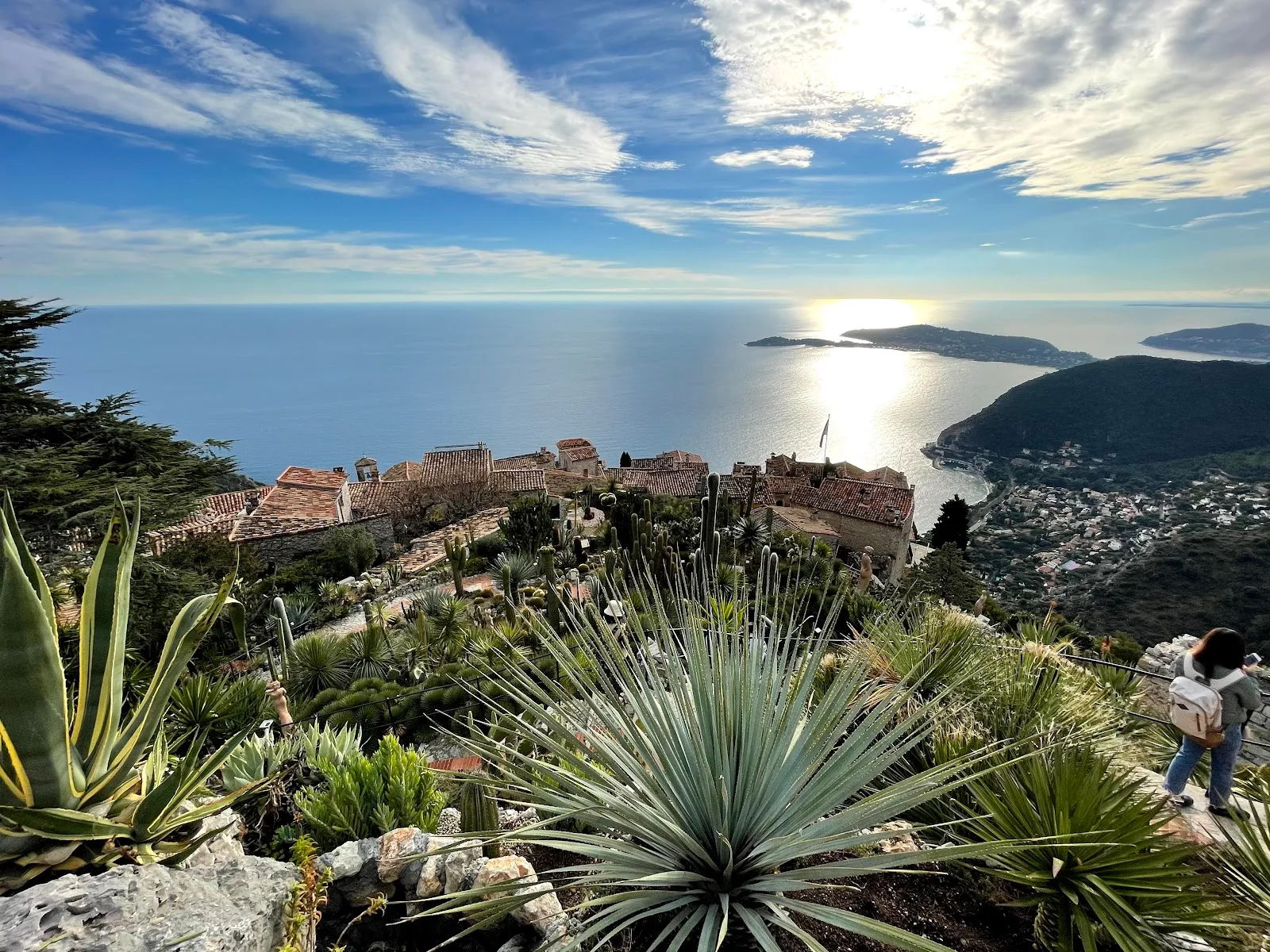
Èze-sur-Mer is the most misleading station on the line. Medieval Èze, the village in all the photographs, sits high on its rock. The station is at sea level. You either take the bus up or walk the Nietzsche path — roughly an hour of serious climbing, and a bad idea at midday in August, with small children, or in sandals. If the village is your target, the Èze–Monaco–Menton day sets out exactly how it connects.
Cap-d'Ail is the last French stop before Monaco: residential, with a good beach and rents a shade more human than its neighbours. Rarely a reason to visit, often a reason to stay.
Monaco-Monte-Carlo is a station cut into the rock on several levels, with exits in genuinely different parts of the principality — choose yours according to where you are going, because the walk between them is real. We will not go into detail here, because getting from Nice to Monaco already has its own article covering it properly.
Roquebrune-Cap-Martin gives you a medieval hill village and a superb stretch of coast, with another climb attached. Carnolès is effectively western Menton, useful if your hotel is there.
Menton is the last French town before the border: the mildest climate on the coast, gardens, citrus, a pastel old town stacked above the sea, and the Lemon Festival in February. Worth half a day on its own. Menton-Garavan is the eastern station, near the gardens and the beaches towards Italy.
Ventimiglia is already Italy — see below, it deserves a trip of its own.
And westbound: Cannes, Antibes, Juan-les-Pins
The same line runs the other way, towards Marseille, and the western half is just as useful: Antibes, Juan-les-Pins, Golfe-Juan, Cannes. Nice to Cannes takes about half an hour and the fare is comparable to Nice–Menton (indicatively around €7–8 one way, 2026). Note that Cannes is west of Nice, the exact opposite direction from Monaco — a compass error that wrecks a lot of itineraries. The details are in our guide to a day in Cannes from Nice.
Fares and journey times
Figures verified in October 2026, standard one-way fares:
- Nice-Ville → Monaco-Monte-Carlo: about €6.10, about 25 minutes
- Nice-Ville → Menton: about €7.70, about 40 minutes
- With a Zou! discount card, Nice–Monaco comes down to roughly €4.30
- Mini-group fare: roughly €3.10 per person from 5 travellers upwards
Villefranche and Beaulieu, being one and two stops out, cost less than Monaco. For a family of four or five, the mini-group fare changes the arithmetic entirely: a day in Menton and back costs each of you less than a coffee in Monte-Carlo.
Tickets: where to buy, and validating them
Nothing needs booking in advance. These regional trains have no reserved seats and no fares that climb as the date approaches. You buy on the day and get on.
Three options: the station machines (English interface, contactless cards accepted, far the quickest), the ticket counter at the larger stations, and the SNCF Connect app or website if you would rather carry the ticket on your phone.
Validation is the part visitors get wrong. A card ticket from a machine must be stamped in the yellow validators on the platform before you board. A phone ticket is not stamped — it is scanned by the inspector. An unvalidated ticket is formally an unused ticket, and inspectors do work this line and do issue fines. Keep the ticket until you are out of the destination station.
Reading the timetable, and how often trains run
On the Nice–Menton stretch, on a weekday, the service is frequent enough that in practice you stop planning: roughly two to three trains an hour in the morning and late-afternoon peaks, something like every 30 minutes across the middle of the day, thinner late in the evening and at weekends. Do not take my word for it: check SNCF Connect or the TER Sud site for your own date, including the last departure back. Screenshot it before you leave — signal at Èze-sur-Mer, or in Monaco's underground station, is not guaranteed.
On station boards, trains are listed by final destination, not by your stop. A train to Ventimiglia will take you to Villefranche, Monaco and Menton; a train terminating at Monaco will not take you to Menton. Find your station in the list of calls on the board or on the platform screen.
A day in Italy: Ventimiglia and the Friday market
This is the part almost no English-language itinerary makes enough of: from Nice you can reach Italy on a regional train ticket. The eastern end of the line is Ventimiglia, the first Italian town past the border, about an hour away. There is no border control on the train and you need nothing more than your ID.
On Fridays, Ventimiglia hosts one of the largest markets on the whole coast, spread through the streets near the sea and drawing coaches from across the French Riviera. Everything is sold — textiles, leather shoes, cheese, olives, fruit — bargaining is expected, and it is crowded and loud in a way the French side of the coast never is. Even on other days the trip earns itself: the old town on the hill, the price of lunch (systematically less than the same lunch in Menton), and the sheer contrast.
Two warnings. Market-day afternoon trains back are full, sometimes unpleasantly so — travel earlier or later than the peak. And your French ticket is valid only as far as Ventimiglia; to carry on to San Remo or Genoa, buy separately from the Italian machines in the station.
The honest warnings
The line does close. Engineering works and strikes genuinely interrupt this railway, sometimes for weeks, with replacement buses that make the journey far longer. There is no safe month, and it does not help you to hear from me what closed last year. What helps: check SNCF Connect or TER Sud for your dates, a few days ahead and again that morning.
Trains fill up. In July and August, on the Nice–Monaco–Menton stretch, peak hours mean standing. During the Monaco Grand Prix, trains to and from Nice are packed and the Monaco station runs on managed flows; if you are coming then, read the Grand Prix travel guide before you fix your plans.
Some stations are small, and up is a long way. Èze-sur-Mer is the obvious case, but Roquebrune demands a climb too. Check what waits for you after you step off, especially with luggage, a pushchair or limited mobility.
The last train matters. Evenings end earlier than you expect, Sundays especially. If the plan is dinner in Monte-Carlo and back to Nice, look up the last departure before you book the table — otherwise the taxi costs more than the meal.
What a week built on the train looks like
A pattern that works: base yourself in Nice, give the city a day, then take short days eastward — Villefranche and Beaulieu together, Monaco on its own, Èze with Menton, Ventimiglia on a Friday — and one day westward to Cannes and the Lérins islands. Each is a morning departure with no planning and a return whenever you have had enough. If you want it already arranged, day by day, we have a 7-day Riviera itinerary.
The one journey the train does not answer is the arrival. With luggage, from the airport, straight to the principality, an airport transfer from Nice to Monaco is simpler and, split between two or four people, stops looking expensive. After that, let other people do the driving.
Plan your trip
Experiences
Tours & activities
Private tours, boat trips and hand-picked experiences via GetYourGuide — free cancellation on most.
See all experiencesGetting to the Riviera
Flights, transfer & car
Nice → Monaco transfer
Private transfer, fixed price, driver waiting — 30 minutes along the coast.