
Nice Beaches Guide: Pebbles, Not Sand — and How to Enjoy Them
Nice's beaches are round pebbles, not sand. Here is what that means in practice, what to bring, what a private-beach lounger costs, which stretch suits families, swimmers or sunset, and where to find real sand minutes away by train.
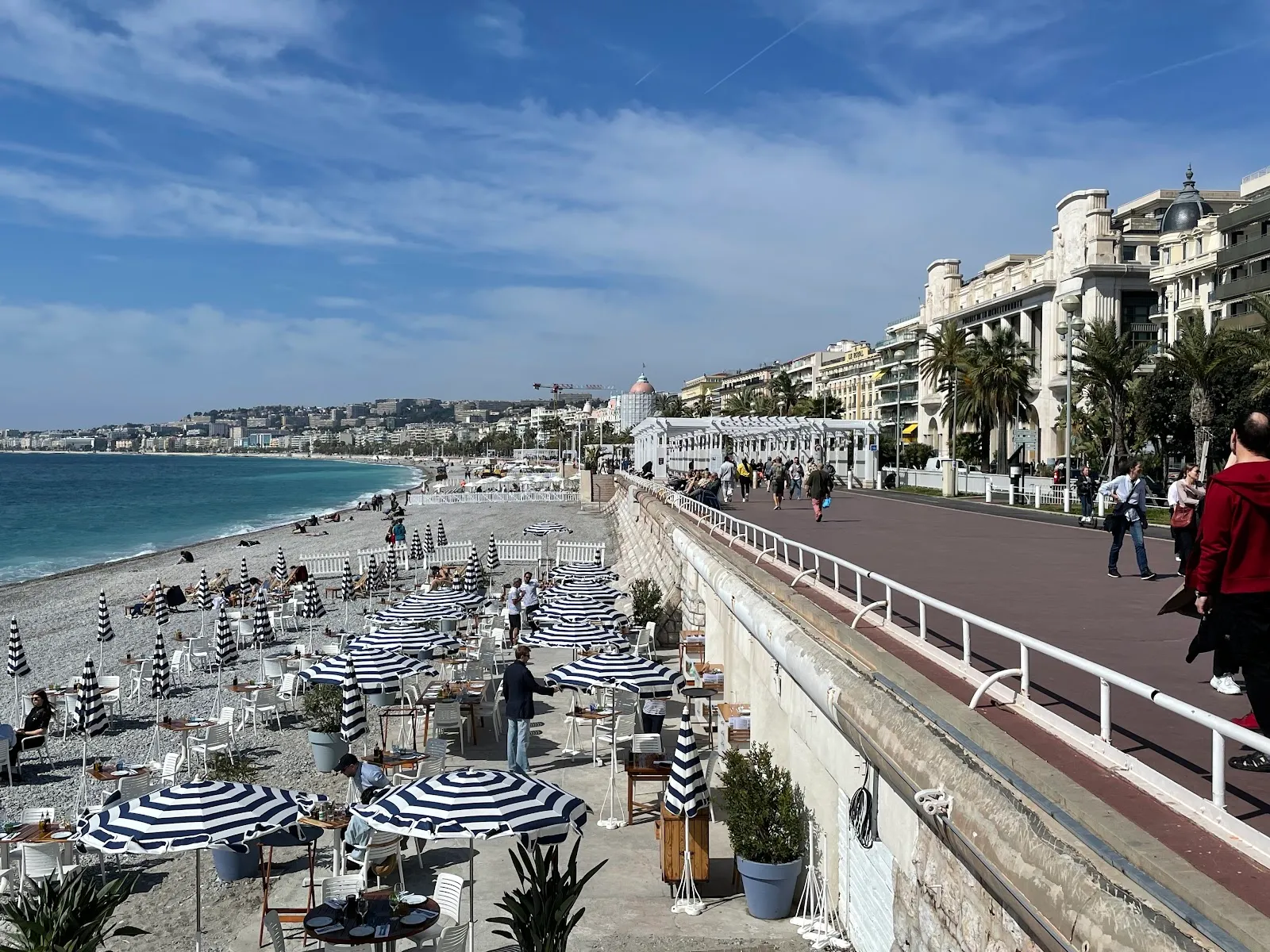
Let us settle first the thing everybody learns too late: the beaches in Nice are not sand. They are pebbles. Not coarse sand, not fine shingle — round stones the size of an egg or a fist, polished by the sea, that shift underfoot with every step. Photographs never show it, because from the Promenade the blue water dominates the frame, and from the air a pebble beach looks exactly like a sandy one.
This is not a flaw; it is a feature. But it is a feature you need to know about in advance, not when your four-year-old is crying three metres from the water. If you are building your trip around Nice as your Riviera base, this guide tells you what to pack, what a lounger costs, which stretch of coast suits whom, and where to find actual sand 10 to 25 minutes away by train.
What pebbles mean in practice
Three immediate consequences.
A towel is not enough. A towel spread over pebbles is a sheet of paper on a pile of marbles: you feel every stone, and after twenty minutes a bone you did not know about starts to ache. The answer is a thick beach mat, a firm roll-up mattress, or what the locals use — a thin inflatable. They cost a few euros in any shop in town and they transform the day.
Water shoes are not an overreaction. The stones are hot at midday and unstable at the waterline, where you also get weed and the occasional sharp edge. Any rubber sandal or neoprene slipper solves it. You will see seventy-year-old French swimmers walk into the sea in plastic shoes and come out upright; barefoot visitors come out the other way, on their backside.
The water is spectacularly clear — precisely because of the pebbles. There is no fine sand to be lifted into suspension by every wave, so the sea stays transparent even on a day with a small swell. That blue-green you saw in the photographs is real, and it is the direct consequence of the thing you are complaining about.
How to get into the water
Nice's beaches shelve steeply. Two or three metres out you are already chest-deep, and the waves break directly onto the stones rather than running up a long flat of sand. The technique is simple: go in facing the sea, slightly sideways, small steps, and do not try to jump a wave. Getting out is the trickier half — the backwash drags the pebbles out from under you and takes your balance with them. Come out between waves, not in the middle of one.
For swimmers this is good news: instant depth, clean water, and you can swim parallel to the shore for hundreds of metres. For small children it is the opposite: there is no knee-deep shallows to splash in for an hour.
Public beaches or private clubs
Along its seven kilometres, Nice's shoreline alternates between plages publiques — free, no facilities beyond a cold shower and a lifeguard post in season — and roughly fifteen private concessions, each with loungers, umbrellas, a bar, a restaurant and a toilet you are allowed to use.
The public stretches are perfectly good. The one in front of the old town (Ponchettes) is the most convenient if you are staying in Vieux Nice; the western ones, beyond Magnan and Carras, are wider and calmer; the Lenval area is the local families' choice. The difference from a private club is not the water, it is the comfort: a flat bed, guaranteed shade, and somebody bringing you a lemonade.
As an order of magnitude for 2026 — indicative figures that vary by club and by season: a single back-row lounger starts around 20–30 € a day, a front-row pair with an umbrella frequently reaches 50–90 €, and in the first half of August the best-known clubs charge more and want a reservation. Many clubs also sell a half day at a lower rate, which is often the smartest buy: four hours of pebbles are far easier than eight. If you want a hotel with its own beach or a negotiated club arrangement, our luxury hotel selection covers exactly that end of the market.
Which stretch, for whom
Families with young children: the western end, beyond Magnan, where the beach is wider, less crowded and closer to the residential blocks and car parks. But be realistic: with a child under five, a full day on pebbles is a negotiation. For a proper sand day, see the next section.
Swimmers: the stretches east of the port, under Mont Boron, where rock replaces pebbles. The Coco Beach area is an amphitheatre of rock with deep, clear water, no facilities and no lifeguard — for people who swim well, not for paddling. You walk there from the port along the same road that climbs to the Mont Boron park.
Sunset: anywhere on the western side, because the Baie des Anges curves and the sun drops into the sea at the end of the promenade. The best combination is a public stretch at around seven in the evening in September, when the water is at its warmest of the year and half the crowd has already gone to dinner.
Where to find real sand nearby
Three answers, all under half an hour away.
Villefranche-sur-Mer, one stop east, has a sheltered bay of mixed sand and fine shingle, calm water and a gradual slope — the nearest solution for families. The bay is closed on three sides, so it is effectively waveless. The whole day out is set out in our Villefranche-sur-Mer day trip.
Antibes and Juan-les-Pins, to the west, have the sandy beaches the Riviera is famous for in the collective imagination: the Plage de la Salis below the old town, and the run of beaches at Juan-les-Pins. Allow about half an hour by train from Nice-Ville.
Larvotto, in Monaco, is imported and maintained sand, with a rebuilt promenade, public sections and clubs, calm water and a lifeguard. If you are doing a Monaco day anyway, put swimming things in the bag: it works very well with children, and the detail is in our guide to Monaco with kids.
Safety and practicalities
There is no shade. Nothing grows on a pebble beach, and you cannot plant an ordinary umbrella between stones without a heavy base. Either you rent, or you bring an umbrella with a solid foot, or you accept that you are in full sun — and in Nice in July, between noon and four, the sun is serious.
Flags and lifeguards. The watch posts operate only through the summer season, roughly mid-June to mid-September, and only on the signposted stretches. Green, yellow, red — red means forbidden, not "take care". For the rest of the year the sea is not supervised at all.
Currents and the shore break. Nice does not have the classic rip currents of an ocean coast, but it does have a wave breaking close in and a bottom that drops away fast; the combination knocks people over every summer, usually on the way out, and especially when the east wind is up. If you see half-metre waves slamming straight onto the stones, postpone the swim.
Sea temperature. This part of the Mediterranean is cold in spring and warm in autumn — the opposite of what people expect. In May the water is still bracing for most people; the best swimming runs from July into October, and in early October the sea is often more pleasant than in June. If you are planning a beach holiday, September is the optimum: warm water, mild air, an emptier city.
One last thing. Do not leave anything valuable on the stones while you swim, on any urban beach, and bring a bag for the wet pebbles your children are going to collect regardless.
Plan your trip
Hotels nearby
Hotels in Nice
Experiences
Tours & activities
Private tours, boat trips and hand-picked experiences via GetYourGuide — free cancellation on most.
See all experiences