
The Best Things to Do in Nice, Honestly Ranked
An honest ranking of Nice: the view from the Colline du Château (where there is no castle), the old town, the Cimiez museums, the port and Mont Boron, market days — plus what is overrated, what is free, and how to dodge the summer crowds.
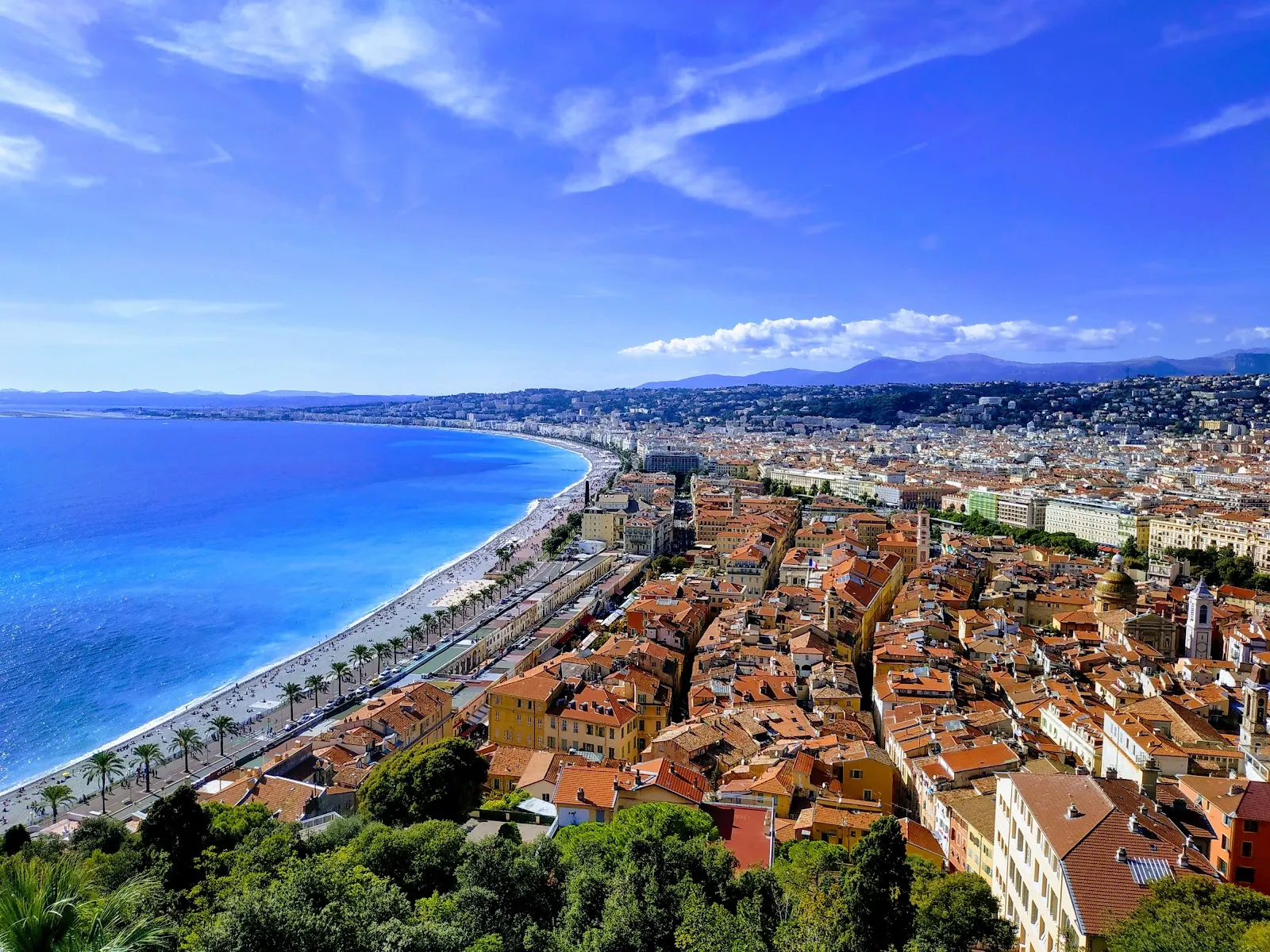
Most people arrive in Nice with the wrong list. They have seen the photographs of the blue chairs on the Promenade des Anglais, read that the city is "the gateway to the Riviera", and block out half a day for it, between a beach and a terrace. Nice holds three days without repeating itself, and the reason is unglamorous: it is not a resort built for visitors but a working city of nearly 350,000 people that happens to have a sea, a historic centre more Italian than French, and two museums you would visit anywhere in Europe.
The order below is not geographical and not chronological. It is ranked by whether the thing is worth your time. If Nice is your base for the coast — and it has every reason to be — then this is what to do on the days you are not taking the train to Monaco, Villefranche or Cannes.
1. Colline du Château: the view that justifies everything else
The hill that closes off the old town to the east has a misleading name. There is no castle. The fortress was demolished in the early eighteenth century after a siege, and what remains is a public park of maritime pines, an artificial waterfall, an old cemetery, and a terrace with exactly the view you have seen on every postcard: the Baie des Anges drawing its perfect arc, the ochre roofs of Vieux Nice, the port on the far side of the rock. Tell someone they are walking up to "the castle" and they will come down disappointed. Tell them they are walking up for the best view in the city and they will come down happy.
There are three ways up: the stairs near the eastern end of the Promenade (steep but short), the slope from the port (longer and gentler), and the lift inside the cliff beside the Tour Bellanda, which removes the climb entirely. That lift is the only argument you need if you are travelling with small children or with parents. Go early in the morning or in the last hour before sunset; at midday in August the terrace is crowded and the light is flat. The park is free and closes in the evening at an hour that shifts with the season — check on the day.
2. Vieux Nice: a quarter to inhabit, not to cross
Vieux Nice is not a set restored for tourists; it is a neighbourhood where laundry hangs out of the windows. The narrow streets between Place Rossetti and Cours Saleya have ochre and Venetian-red facades, baroque churches with interiors far richer than their plain fronts suggest, and a density of bars and restaurants that becomes exhausting by seven in the evening. The trick is to turn into the side streets: Rue Droite, Rue Benoît Bunico, Rue de la Loge. Two streets off the main axis, prices drop and French returns to the neighbouring tables.
Cours Saleya is the old town's market square, a long rectangle under plane trees, flowers and produce from Tuesday to Sunday and antiques on Mondays. In the morning it is a genuine market; after one in the afternoon it becomes a run of terraces all serving roughly the same salad. See it at nine, have your coffee there, and eat elsewhere — the details are in our guide to eating in Nice.
3. Promenade des Anglais: overrated as a sight, essential as a ritual
This needs honesty. Seven kilometres of seafront promenade is not an attraction. There is nothing to visit: it is a wide pavement, a row of Belle Époque hotels, the blue chairs that became the city's emblem, and traffic on the other side. If you have read that the Promenade des Anglais is "the heart of Nice", you have read a press release.
And yet you will walk it daily, because it works as a ritual: from the Jardin Albert Ier to the Hôtel Negresco before breakfast or at sunset, with the sea on your left. Stay on the pedestrian lane rather than the cycle lane — locals ride seriously here. The western end is markedly less crowded. The beaches below are pebble, not sand, and that changes how you plan your whole day: it is all explained in our Nice beaches guide.
4. Cimiez: Matisse, Chagall and a Roman site on the same hillside
If you have one cultural morning, spend it in Cimiez, the quarter on the hill behind the city. The Musée Matisse occupies a red Genoese villa in an olive grove and holds the collection the artist left to the city where he spent his last years: cut-outs, drawings, the models for the chapel at Vence. It is a small, human museum that takes 60 to 90 minutes.
A few minutes' walk away is the Musée National Marc Chagall, built specifically for the painter's biblical cycle, with stained glass and a reflecting pool. Many visitors rank it first in the whole city, and they are not wrong. Between the two, on the same slope, lie the ruins of the Roman town of Cemenelum — baths and arena, freely accessible in the public park. Museum entry is paid and tariffs change, so check before you go; as an order of magnitude, in 2026 a municipal museum ticket in Nice sits indicatively in the 10–15 € per person range, and the city also sells a multi-museum pass. Get there on bus 5 from the centre, or tram 1 to Valrose and then a bus — a single Lignes d'Azur ticket is 1.70 €, valid 74 minutes including connections, and a day pass is 7 €.
5. The port and the walk round to Mont Boron
The part of the city visitors miss most often is the part beyond the hill. Port Lympia, with its rectangular basin cut in the eighteenth century and its red facades, has yachts, the Corsica ferries, and the liveliest dinner quarter in town. It is not spectacular; it is simply real, in the dull sense that people live there.
From the port begins the best walk in Nice: up Boulevard Franck Pilatte past the small clear-water coves, then onto the paths of the Parc du Mont Boron, a pine forest looking across to Cap Ferrat and, on clear days, to Italy. Allow two hours there and back, ordinary shoes, water. It is free and, in July, it is the one part of the city that is not crowded. From up there you can also see precisely why Nice makes a good base: everything on that coastline is 20 to 40 minutes away by train.
6. Market days, if you catch the right one
Nice has a real market culture, not a decorative one. Cours Saleya runs flowers and produce Tuesday to Sunday mornings and antiques on Mondays — the Monday brocante is a serious one, with furniture, silver and posters, and worth an hour even if you buy nothing. The Libération market, around the old northern station, is the one locals actually use: bigger, cheaper, with no concessions made to visitors, two tram stops from the centre. Go before eleven; after that it packs up.
What is overrated, briefly
The tourist road train on the Promenade: expensive for what it is, and the climb to the Colline du Château is better done on foot or by lift. The private beach in front of the Negresco in August: you are paying for the address. The photo-menu restaurants on Cours Saleya after one o'clock. And, at the risk of annoying people: the MAMAC modern art museum is uneven — go if Nouveau Réalisme and Yves Klein interest you, otherwise give Chagall the priority.
On crowding, so there are no surprises: from July to mid-September the old town in the evening and the Promenade at sunset are full, and the first half of August is the absolute peak. May–June and September–October give you the same city with half the people and a sea that is still warm.
What is free
The Colline du Château and, in many periods, its lift; the Promenade des Anglais; the public beaches; Cours Saleya and the Libération market; the Roman ruins and olive grove in Cimiez; the Parc du Mont Boron and the walk out from the port; the churches of Vieux Nice; Place Masséna and the Promenade du Paillon. Many municipal museums are free on the first Sunday of the month — check the date on the city's site. In other words, you can have two very good days in Nice paying only for food and transport.
How to put it together
One day: the old town in the morning, the Colline du Château at midday, the port and Mont Boron in the afternoon, dinner in Vieux Nice. Two days: add Cimiez on the second morning and a beach in the afternoon. Three days: give the third to the coast — a day in Monaco from Nice is 25 minutes and €6.10 each way, and if you want more excursions and experiences, our things-to-do section gathers them in one place.
Plan your trip
Experiences
Tours & activities
Private tours, boat trips and hand-picked experiences via GetYourGuide — free cancellation on most.
See all experiencesGetting to the Riviera
Flights, transfer & car
Nice → Monaco transfer
Private transfer, fixed price, driver waiting — 30 minutes along the coast.