
Where to Eat in Nice: Niçoise Food, by Situation and by Price
Nice does not have French cuisine; it has Niçoise cuisine: socca, pissaladière, pan-bagnat, petits farcis, daube with ravioli. What to order, what a real salade niçoise does not contain, where to eat for a market breakfast, a cheap lunch or a proper dinner — and how to sidestep the Cours Saleya traps.
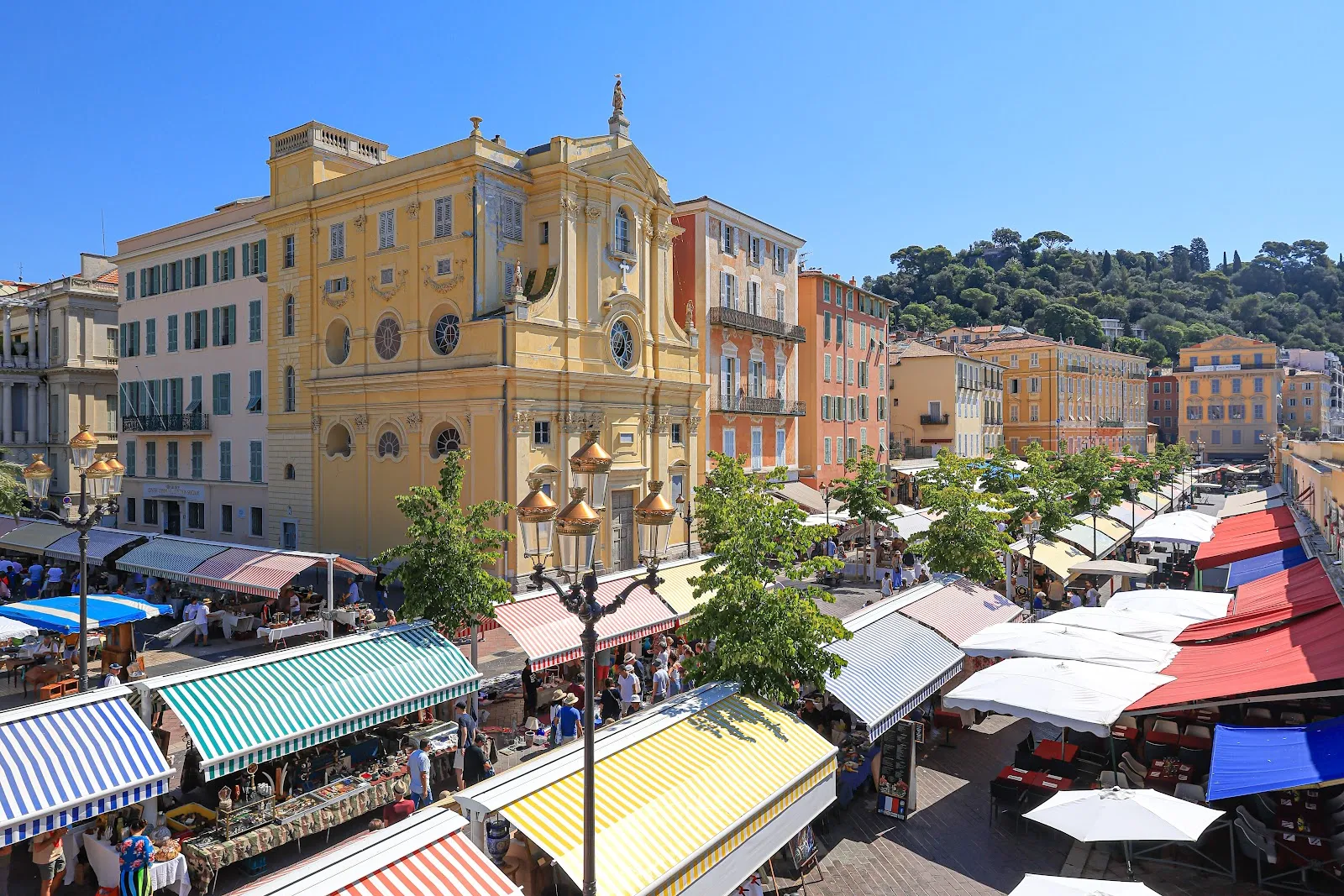
The first correction a visitor to Nice has to make is to stop looking for "French food". You will not find it, or you will find it badly done. Nice was Italian — part of the County of Nice, under the House of Savoy — until 1860, and its cooking stayed there: olive oil instead of butter, chickpeas, anchovy, raw vegetables, herbs, ravioli, gnocchi. Cuisine nissarde is the food of a poor city with a rich market, not of a cream sauce. Understand it that way and the city becomes far more interesting at the table.
This guide works on two axes: what you eat, and in which situation. If you are using Nice as your Riviera base, you will take most of your holiday meals here, so it is worth knowing what to order.
Socca, and how it is actually eaten
Socca is a thin pancake of chickpea flour, olive oil, water and salt, baked in a wide copper tray in a wood-fired oven until the edges crisp and black blisters appear. It is not an elegant dish and does not need to be.
The way it is served is half the story: it is scraped off the tray with a spatula, piled onto a paper plate, dusted with coarsely ground black pepper, and handed to you scalding. You eat it with your fingers, standing up, immediately. Cold socca is a disappointment — it goes soft and tastes of cardboard. If you see socca being kept warm under a lamp, walk on. And do not order a portion "for later": there is no later.
As an order of magnitude, indicative for 2026: a portion of socca sits around 3–5 €, with a glass of local rosé beside it another 4–6 €. It is the best pleasure-per-euro in the city.
The other things you are looking for
Pissaladière. A bread dough topped with onions cooked down very slowly until sweet, with anchovy — or pissalat, the fermented fish paste that gives the dish its name — and small black olives. It contains no tomato. If what arrives looks like a pizza, it is not pissaladière. Buy it by the slice from a bakery and eat it at room temperature.
Pan-bagnat. A round roll soaked in olive oil with tuna or anchovy, hard-boiled egg, tomato, spring onion, pepper and olives. It is not toasted, has no mayonnaise, no lettuce, and is never heated. A good one is wrapped tight in paper and left for twenty minutes so the bread absorbs the oil and tomato juice. Indicatively 6–9 € at a decent bakery, and the perfect lunch to take to the beach — see our beaches guide for the rest of that logistics.
Salade niçoise, and what a real one does NOT contain. This is where most of the arguments happen. The authentic Nice version is a salad of raw vegetables: tomato, spring onion, pepper, cucumber, broad beans or small artichokes, plus anchovy or tuna, hard-boiled egg, Nice olives, basil and olive oil. No potatoes. No green beans. No rice. Traditionally no vinegar, and certainly no creamy dressing. The boiled-potato-and-green-bean version is a Parisian-international invention; eating it is not a scandal, but know that it is not the local dish.
Petits farcis. Small vegetables — courgette, tomato, pepper, onion — stuffed with minced meat, bread and herbs, baked and served warm or at room temperature. This is Niçois family Sunday food and one of the dishes by which you recognise a serious bistro.
Daube niçoise. Beef in red wine with carrot, onion and sometimes dried mushrooms, cooked for a very long time. The important part: here it is not served with mashed potato but with gnocchi or with ravioli à la niçoise — ravioli filled with yesterday's leftover daube mixed with chard. If you see "raviolis niçois" on a handwritten board, order them.
Look out for, if you have time: courgette flowers in batter, tourte de blettes (a sweet chard tart with raisins and pine nuts — better than it sounds), and estocaficada, the stockfish stew that is a test of nerve and of authenticity at the same time.
Where to eat, by situation
Market breakfast. Get to Cours Saleya between eight and ten, buy fruit from a stall and a slice of pissaladière from a bakery behind the square, and drink your coffee standing at a counter rather than sitting at a view terrace. The serious alternative is the Libération market, two tram stops away, where locals shop and the coffee costs half. The market winds down before noon; see also what to do with the rest of the day.
Cheap lunch, no compromise. Three formulas, all good: socca from an old-town stall; a pan-bagnat from a bakery, eaten on the beach or in the Jardin Albert Ier; or the formule du midi at a neighbourhood bistro — two courses at a fixed price, indicatively 18–26 € in 2026, often the best value of the day, because the same kitchen charges far more in the evening.
A proper dinner. Look for a small bistro in the side streets of Vieux Nice (Rue Benoît Bunico, Rue Droite and the parallels) or around Port Lympia, which is where the people of Nice actually go out. Book: the good places have twenty covers and fill from eight. Indicatively, three courses à la carte with a glass of wine runs 35–55 € a head. Kitchens close earlier than you expect, and many places shut on Sunday evening and Monday.
The splurge. Nice has high-end tables, including inside the historic hotels on the Promenade, and for a real gala evening you have Monaco 25 minutes away by train anyway. If you want the options laid out with a booking link, our restaurants section gathers them; and if you want to eat in the principality without paying for the brand, Monaco on a budget shows you exactly where the people who work there eat. Indicatively, a tasting menu on this coast starts around 90–120 € and climbs past 200 € quickly.
How to avoid the Cours Saleya traps without being a snob
Let us be fair: the terraces on Cours Saleya are not a scam. They have an exceptional position, pay rent to match, and feed several thousand people a day, decently. But the price includes the view, and the kitchen is built for volume. If you are at peace with that, sit down and enjoy it. If you want better food for the same money, here are the signals.
Warning signs: a menu with photographs; a laminated card in six languages; someone inviting you in from the pavement; a menu too long, with pizza, pasta, burgers and salade niçoise on the same page; a "menu touristique" displayed large at a round number.
Good signs: a handwritten board that changes; five or six main courses rather than twenty; at least one genuinely nissard dish on the list (farcis, daube, ravioli, estocaficada); tables occupied by people speaking French; and the simplest rule in the world — two streets back from the market, the price drops by a third and the quality rises.
Three details that save friction: service is included in the price in France, so there is no 15% tip — you round up or leave a few euros if it was good. You can ask for "une carafe d'eau", free tap water, in any restaurant. And lunch is served within a strict window, usually until two o'clock; arrive at 2.30 and you will eat badly in a city where, an hour earlier, you would have eaten very well.
Plan your trip
Hotels nearby
Hotels in Nice
Experiences
Tours & activities
Private tours, boat trips and hand-picked experiences via GetYourGuide — free cancellation on most.
See all experiences