
Èze Village: A Complete Guide — How to Get Up, What to See, When to Go
The medieval village sits high on its crag while the station is at sea level — and that is where every mistake begins. The three ways up and who each suits, the Chemin de Nietzsche at its real difficulty, the Jardin Exotique, Fragonard, and the exact hour to be there.
The village is up there, the station is down here — that is where the trouble starts
Èze is the most photographed village on the French Riviera and the one people most often get wrong. Not because it is overrated — the view from the top is, objectively, the best on this stretch of coast — but for a purely topographical reason that far too many visitors discover on the day itself, in the wrong shoes.
There are, in effect, two places with the same name. Èze-sur-Mer is the quarter at sea level, with the railway station and a small beach. Èze-Village is the medieval village, a nest of stone clamped onto a crag more than 400 metres above the water. Between them is a steep hillside. The train drops you at the bottom; the village you saw in the photographs is at the top. There is no funicular, no lift and no flat short cut.
None of this is an argument against Èze. It is simply the information you need in order to choose your way up, because the whole day hangs on that choice. How the coastal line works, what tickets cost and what to check before you set out are covered in our guide to the Riviera by train — and Èze is precisely the case where the train alone is not enough.
The three ways up, and who each one suits
1. The direct bus from Nice, along the Moyenne Corniche. The simplest option and, for most people, the right one. It leaves Nice and climbs the middle corniche to the entrance of the village in roughly half an hour, with a view that is already half the experience. The fare is the urban/departmental one: a single Lignes d'Azur ticket is €1.70, and the "Ticket Azur" at €2.50 covers one urban trip plus a connection on a departmental line — exactly the combination that is useful here. The drawback: there are only a handful of departures an hour and in high season they fill up. Check the timetable on the day, and do not build your plan around a single bus.
2. The train to Èze-sur-Mer, then the shuttle up. The logical choice if you are coming from Monaco or Menton, or if you want an hour on the beach as well. The train stops at Èze-sur-Mer, and a bus climbs from the station to the village. The warning that matters: the shuttle runs only a few times a day. Miss it and you are waiting a long time or walking — so photograph the timetable at the stop the moment you step off the train, and plan your return before you go up.
3. A taxi or a driver. Expensive per head, but reasonable value if there are three or four of you, if it is August, if you have small children, an elderly parent or a tight schedule. Climbing the Moyenne Corniche in a car that stops where you want it to is a different kind of day. The climb is exactly why Èze appears in almost every private tour itinerary on this coast: it solves the village's one real problem.
The Chemin de Nietzsche: what "about an hour's climb" actually means
The footpath between Èze-sur-Mer and the village is called the Chemin de Nietzsche, because the philosopher walked it while working on part of Thus Spoke Zarathustra. It is a beautiful route, with the sea in view almost the whole way, and it is a serious climb: roughly an hour, on uneven stone steps, with more than 400 metres of ascent, long stretches with no shade at all and no water anywhere on the way.
Who will enjoy it: people used to hill walking, in shoes with grip, early in the morning or outside the summer, with a bottle of water in the bag. Who should not attempt it: anyone in sandals or espadrilles, anyone at two in the afternoon in August, anyone with unreliable knees, anyone carrying a toddler. With a pushchair it is simply impossible.
The advice that works for nearly everybody: go up by bus and come down on the path. Downhill it is a forty-minute walk, cool if it is evening, with the sea getting closer all the way — and at the bottom you have the Èze-sur-Mer beach and the station, with a train back to Nice in minutes.
The Jardin Exotique and the view that earns the trip
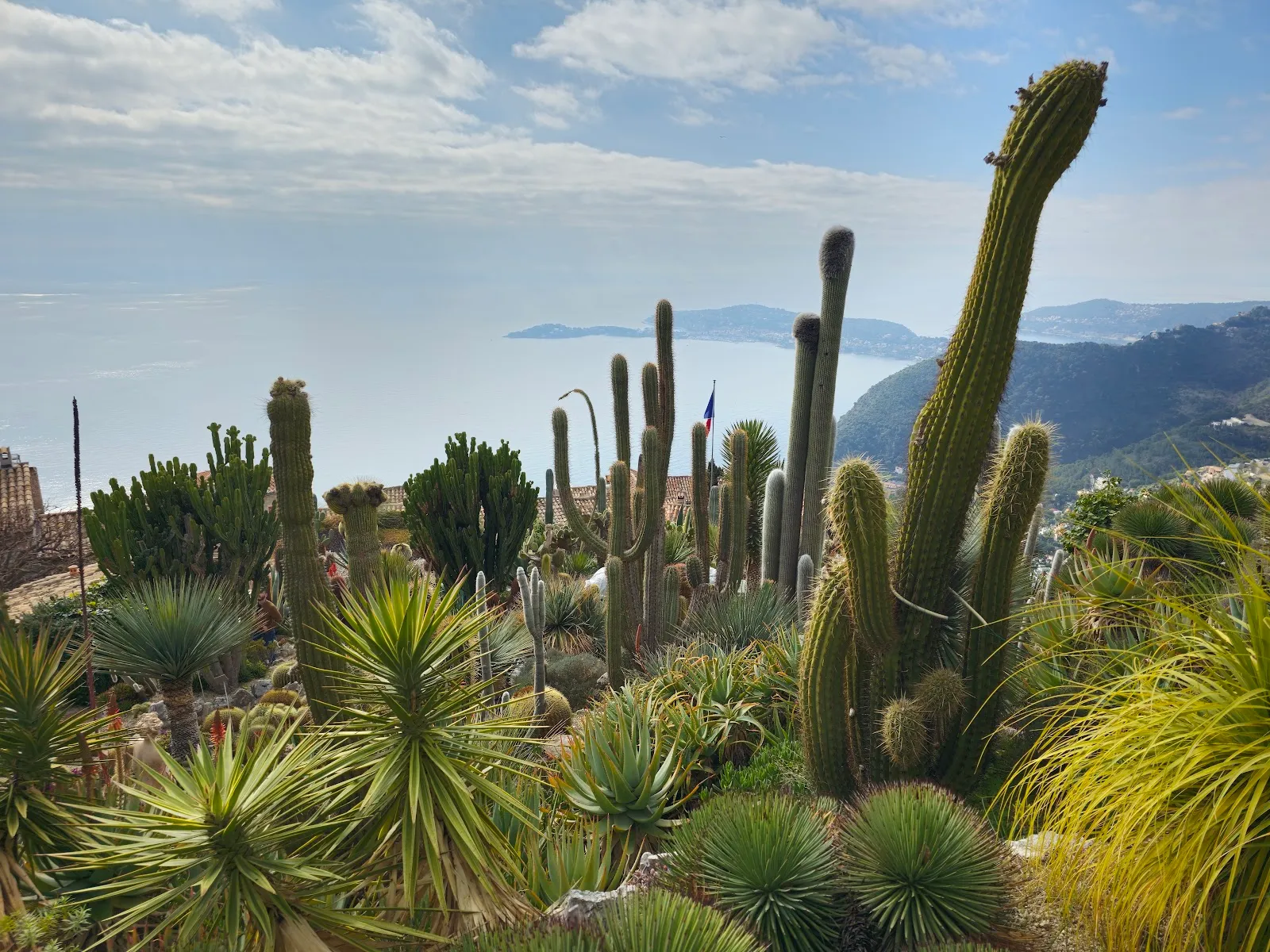
At the top, on the site of the castle demolished in the eighteenth century, sits the Jardin Exotique d'Èze — a garden of cacti and succulents planted on the terraces of the ruin after the war, with female statues scattered among the agaves and a final terrace more than 400 metres above the sea. From there you see the coast from Cap Ferrat to, on clear days, the Esterel. It is the view you came for, and the ticket — modest, indicatively under ten euros in 2026 — is the best-spent money of the day.
Two things to know: the garden is a sequence of terraces and steps, so it asks for decent legs; and, being the highest point of the village, it is also the most exposed — at noon in July there is no shade at all.
The lanes, the perfumery and the free tour
The village itself is walked, on stone lanes a metre and a half wide, through vaulted passages, up stairs, past workshops. The oldest building is the fourteenth-century Sainte-Croix chapel; the neoclassical parish church of Notre-Dame-de-l'Assomption is surprisingly bright inside. The rest is a mix of galleries, ceramic studios, olive-oil boutiques and a few restaurants with terraces hanging over the drop.
Be ready for this, though: Èze is tiny and, in the middle of the day, it is commercial. You can walk the whole village in forty minutes if you do not stop; between eleven and four the lanes are full, and a share of the shops sell exactly what every souvenir shop on the coast sells.
The useful exception is the Fragonard perfumery, at the foot of the village on the corniche, which runs a free tour of its laboratory: short, unpretentious, and genuinely informative about how a perfume is composed and why it costs what it costs. It ends, predictably, in the shop — but it is a well-spent half-hour and one of the very few free things in Èze.
Chèvre d'Or and Château Eza: when the splurge is worth it
Èze has two addresses that turn an outing into an occasion. La Chèvre d'Or is a hotel and restaurant strung through several medieval houses, with stepped terraces and a Michelin-starred kitchen; Château Eza is its smaller neighbour, with a terrace suspended over the void that is probably the most dramatic table on the Riviera.
Prices match the ambition: indicatively, for 2026, a set lunch at restaurants of this level starts somewhere around €100–150 per person, and dinner with wine can double that. The sensible version, which we would actually recommend: a glass or a coffee on the terrace at sunset. You pay a fraction and the view is identical. Book, even for a drink.
How long to give it, and what time to be there
Èze is not a full-day destination. Two hours in the village, three at most — the garden, the lanes, a terrace — plus the travel. That is why it pairs so well with something else: with Monaco, three stops further on, or with a stop at Villefranche on the way back.
The hour of the day, though, is everything. The coaches arrive around ten and leave around four or five. Between those times, a few thousand people are funnelled into lanes a metre and a half wide. Be there before half past nine — the stone is cool, the shops are only opening, the garden is nearly empty and the light is perfect — or after five, when the coaches have gone, the sun is dropping towards Cap Ferrat and the village turns back into a place where people live. At midday in August, we would not send anyone to Èze.
Who it does not suit
With a pushchair, Èze is difficult to the point of hostile: steps everywhere, uneven paving, no flat alternative to any lane. With limited mobility, the lower village is partly feasible if a car brings you to the entrance, but the garden at the top is not. With children under six, take the bus or a taxi and accept that the last stretch of the garden will be done on your arms.
If that sounds discouraging, pick something else for the day: our list of things to do in Nice has flat, shaded options, and Menton as a day trip, at the other end of the line, is a spread-out town with accessible gardens and no climbing.
How it fits the rest of the coast
For a first day on the Riviera, the classic combination is covered separately in our Èze–Monaco–Menton day — three stops on one line, with Èze in the morning while it is empty. If you have more time, Èze instead deserves half a day of its own, at the first or the last light; everything else about the village, including what is open now, is on our Èze page.
One thing to take away from all of this: choose your way up before you leave Nice, not on the platform at Èze-sur-Mer while looking at a 400-metre hillside.
Plan your trip
Experiences
Tours & activities
Private tours, boat trips and hand-picked experiences via GetYourGuide — free cancellation on most.
See all experiencesGetting to the Riviera
Flights, transfer & car
Nice → Monaco transfer
Private transfer, fixed price, driver waiting — 30 minutes along the coast.